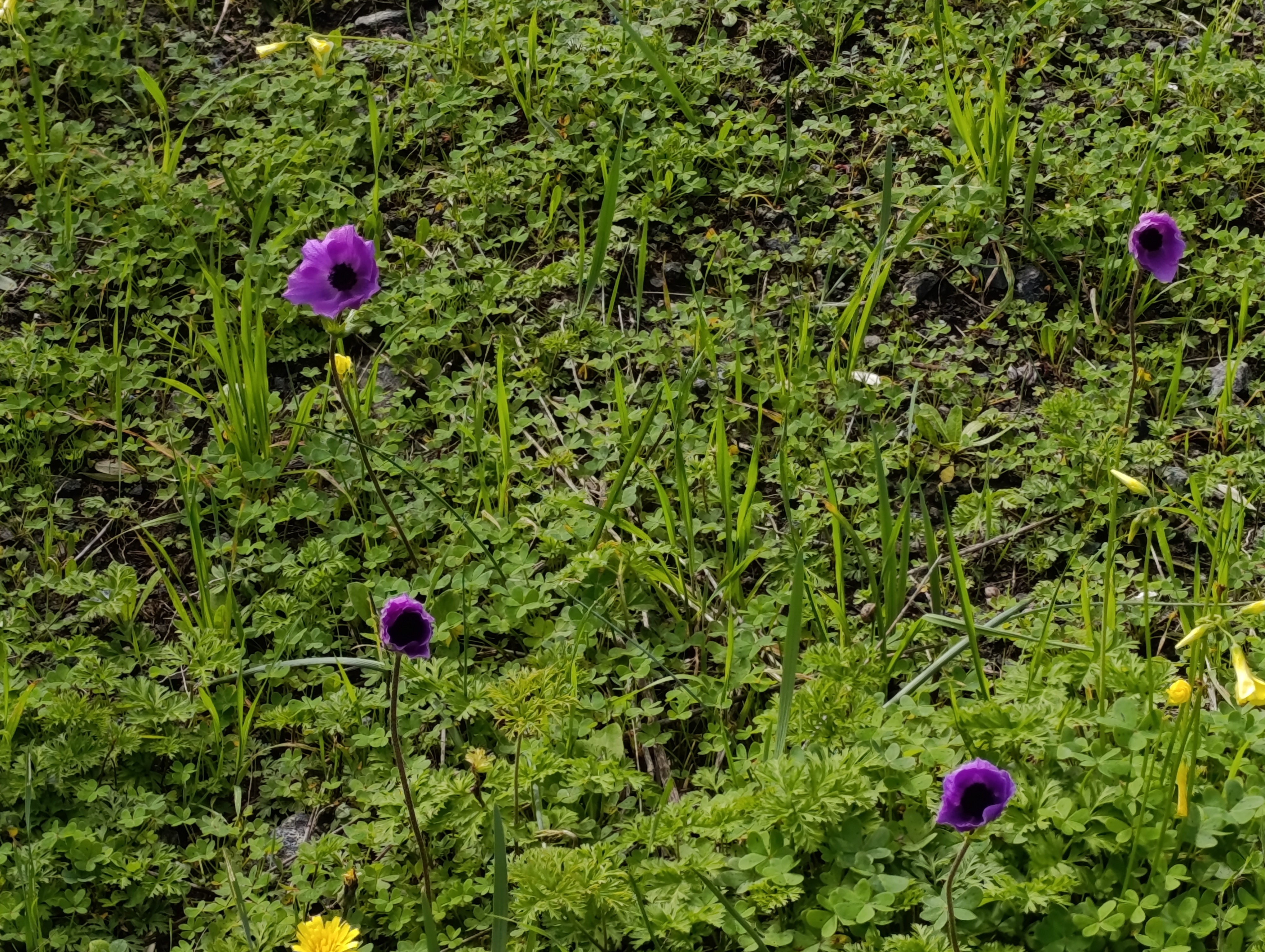
Spring has finally arrived on the island of Crete. Despite the lingering chill of the air, the cloudy skies, and the occasional downpour, the season brings a sense of renewal. Flowers unfurl their delicate petals, birds sing sweet melodies through the branches, crows croak from distant fields, sunlight gently filters through the trees, and bees hum their ancient chorus as they wander from flower to flower.
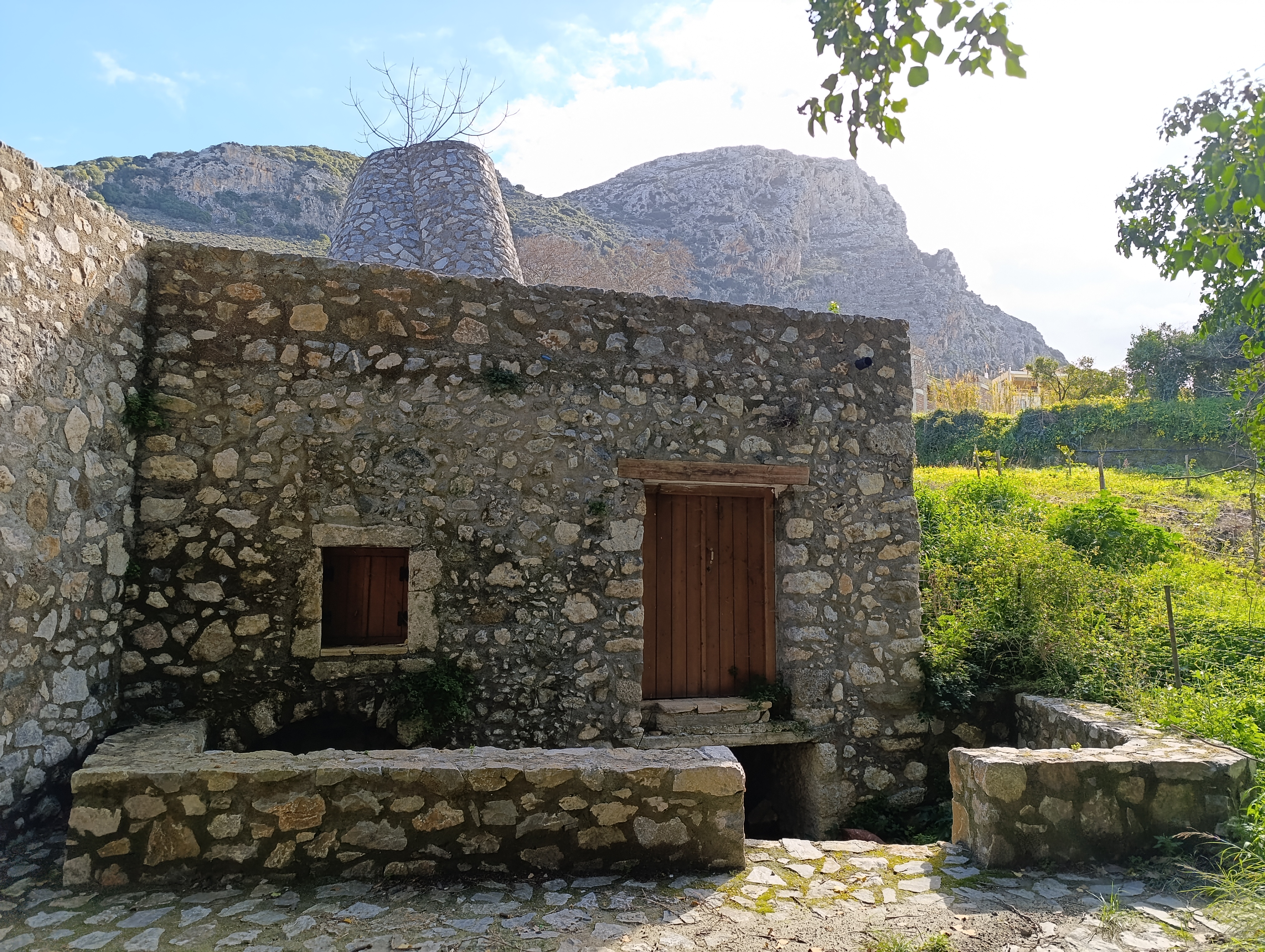
In the village of Spili, nestled below the foothills of Mount Vorizi, a small river weaves its way through the woodland. Along its banks lie the ancient stones of two Venetian-era watermills, remnants of a time when masterful channels and leats directed the river’s strength to turning the mill wheels. Once, seven mills lined this waterway, grinding and filling the valley with the rhythm of work and life.
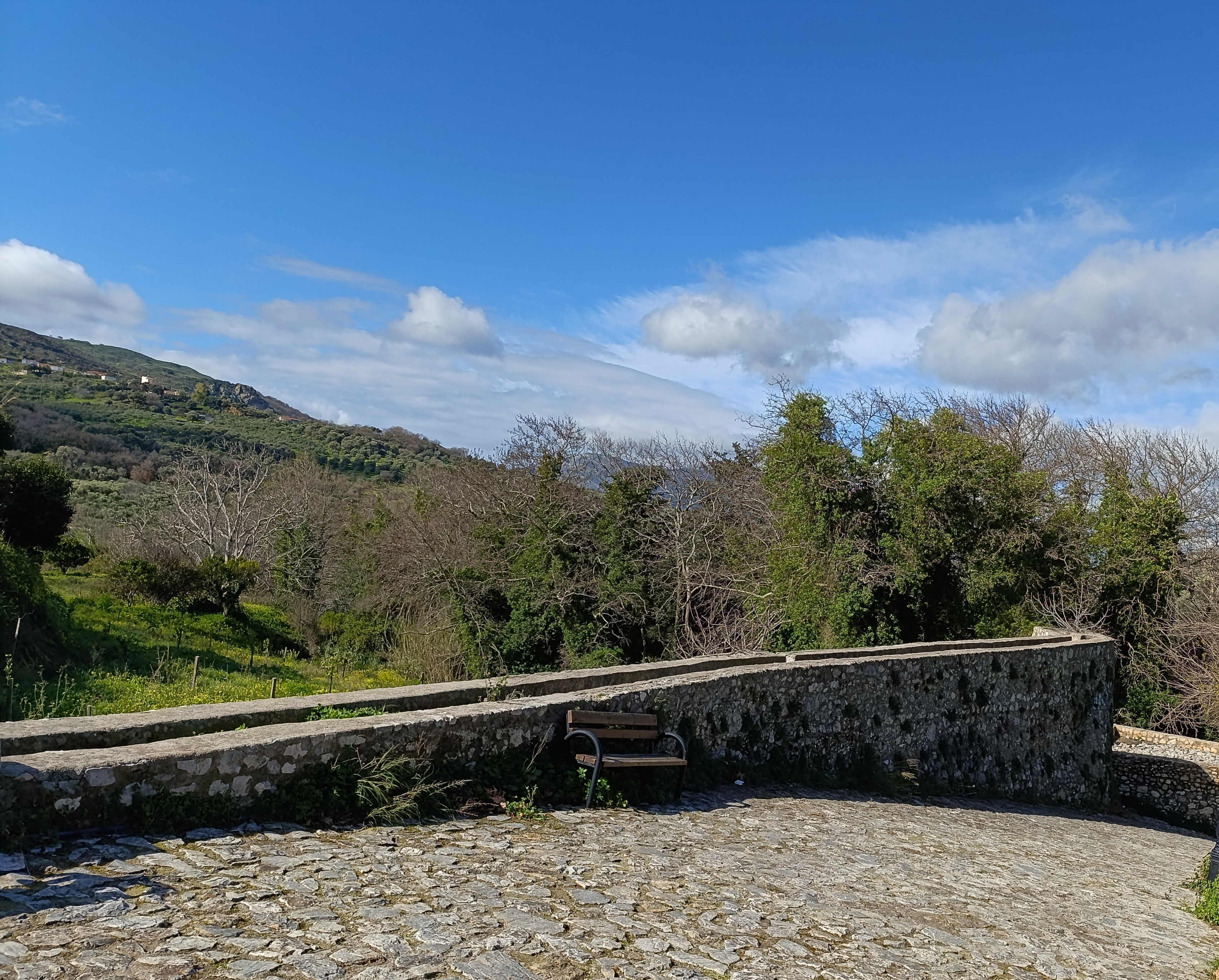
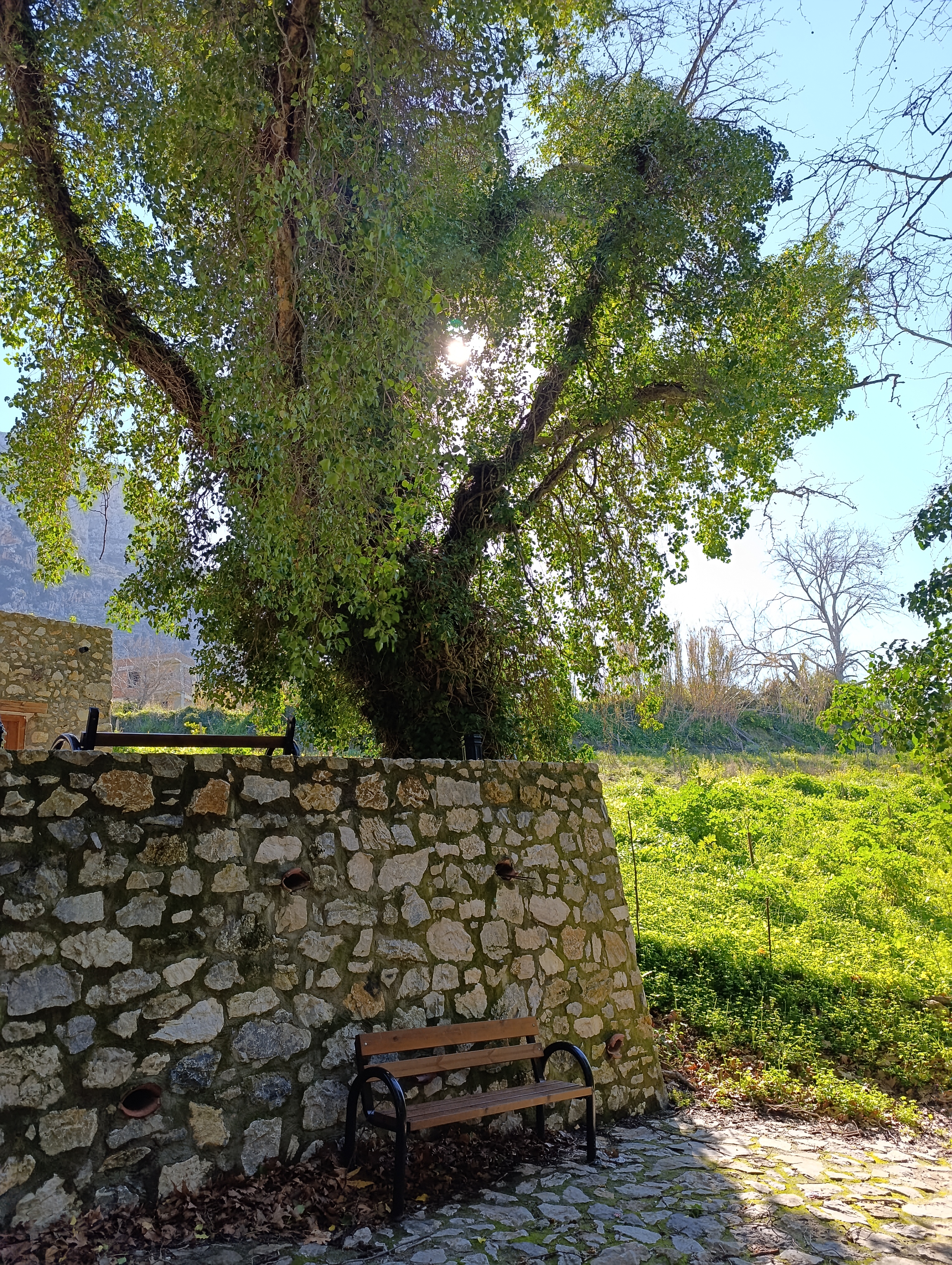
Today, the riverbank is a haven of natural beauty, a peaceful walk shaded by towering plane trees, their bark wrapped in climbing ivy. Fallen autumn leaves soften the earth, and a dragonfly glides past, settling on a leaf beside the clear-running stream.
A small bridge leads to the lower stream, where a winding path beckons you forward, inviting you to wander among the village’s flora and wildlife. In the shaded pools, Freshwater trout move with gentle ease, their speckled bodies hidden beneath the shifting water.
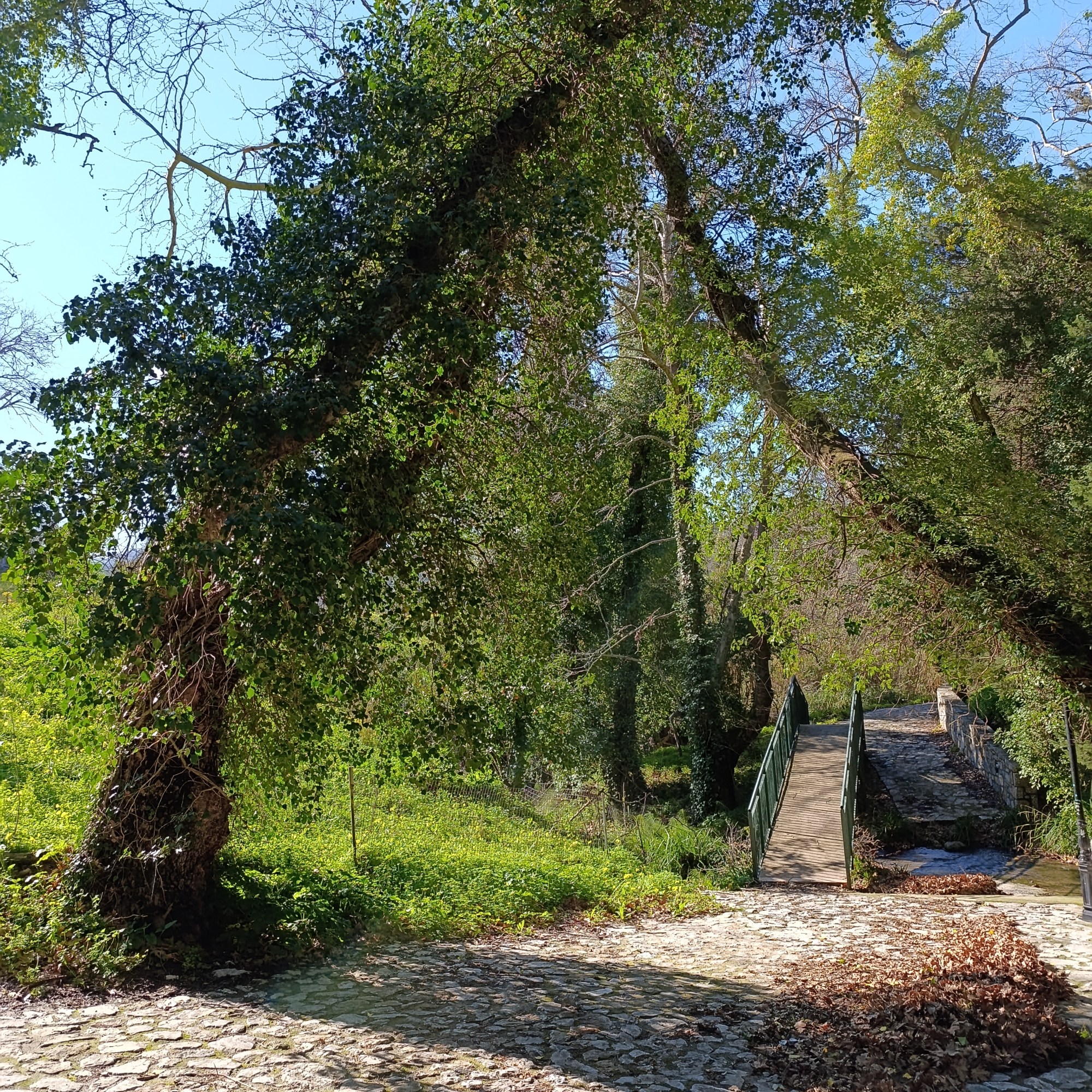
As you walk, you are welcomed by the sounds of bird song, butterflies, dragonflies, and wild herbs, making it a perfect place to relax and immerse yourself in nature’s harmony. Please watch the video below to see the flowing stream.
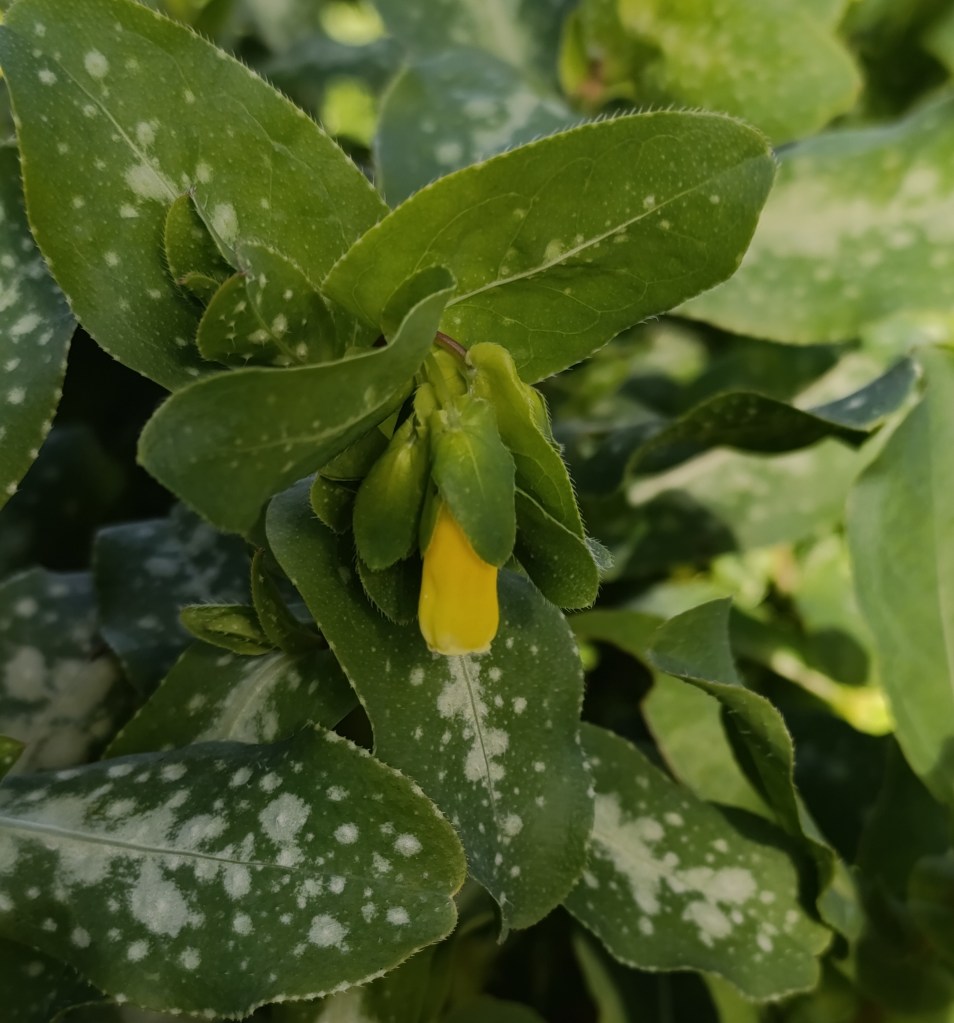
As I walked along the path, I spotted honeywort, Cerinthe major L, growing in the damp undergrowth beneath the tall plane trees. Its yellow, tube-shaped flowers stood out among leafy bracts and broad green leaves marked with white splashes and rounded edges.
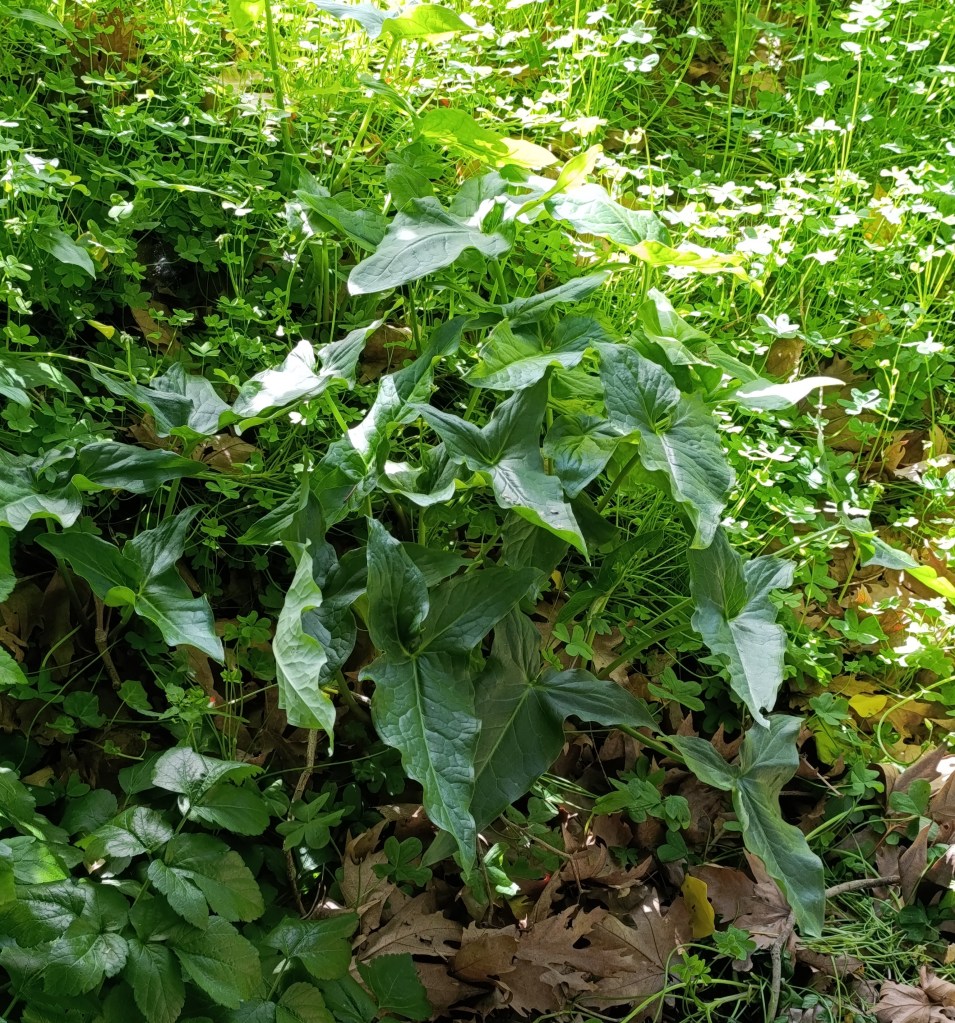
Arum also grows beneath a tree (pictured below), waiting patiently for its time to flower from March to May. Its triangular, dart-shaped leaves stretch through the undergrowth, where autumn leaves mingle within. When the large sheathing bract of the flower appears, it is yellow-green with violet around the edge and a yellow spadix. There are 14 species of this plant in Greece.
This ancient Horsetail species (below) has survived for 300 million years, predating the Mesozoic age when dinosaurs roamed the Earth. It grows beside streams, with underground roots that form intricate systems, extending down to 2 meters deep. If a piece comes away, it can float downstream and establish new colonies. The tiny black-tipped scales along the stems are leaves, but they are so small that the stems perform most of the photosynthesis. This plant produces spores instead of flowers.
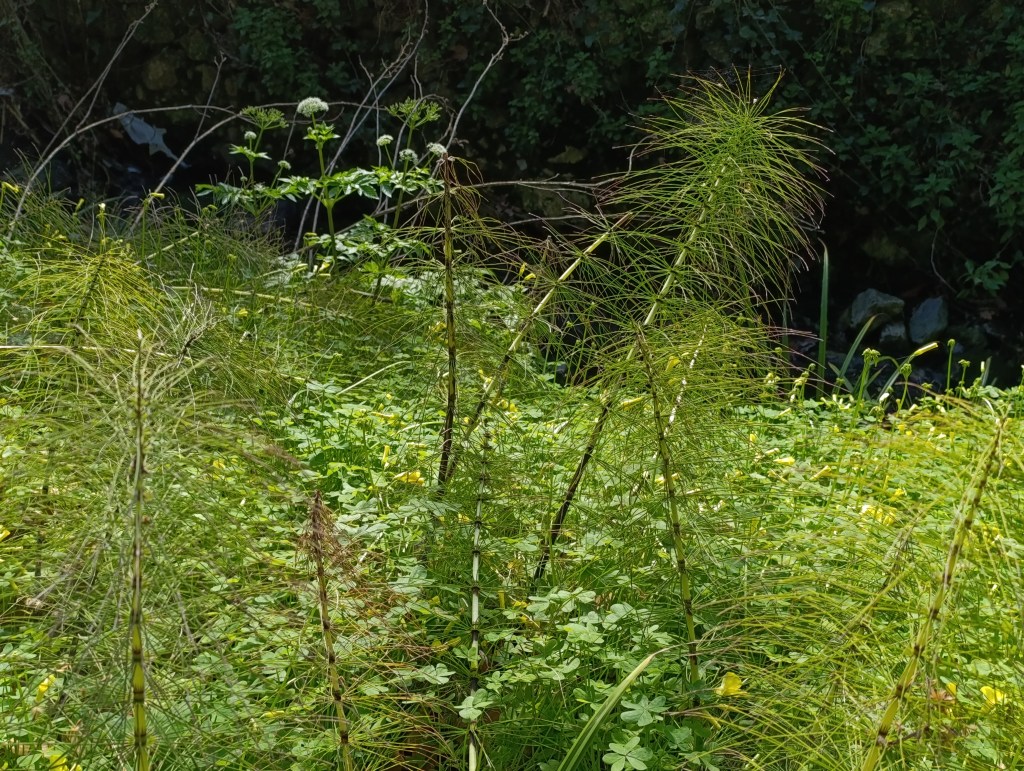
Behind the horsetail, wild angelica (Angelica sylvestris), also known as the holy ghost or woodland Angelica, grows near the river. It has a sweet, carrot-like aroma and prefers damp areas and river banks, making close observation challenging. It’s flowers form large, umbrella-shaped clusters (umbels) of small white flowers, and its divided, pinnate leaves have a slightly inflated sheath at the base where they join the main stem.
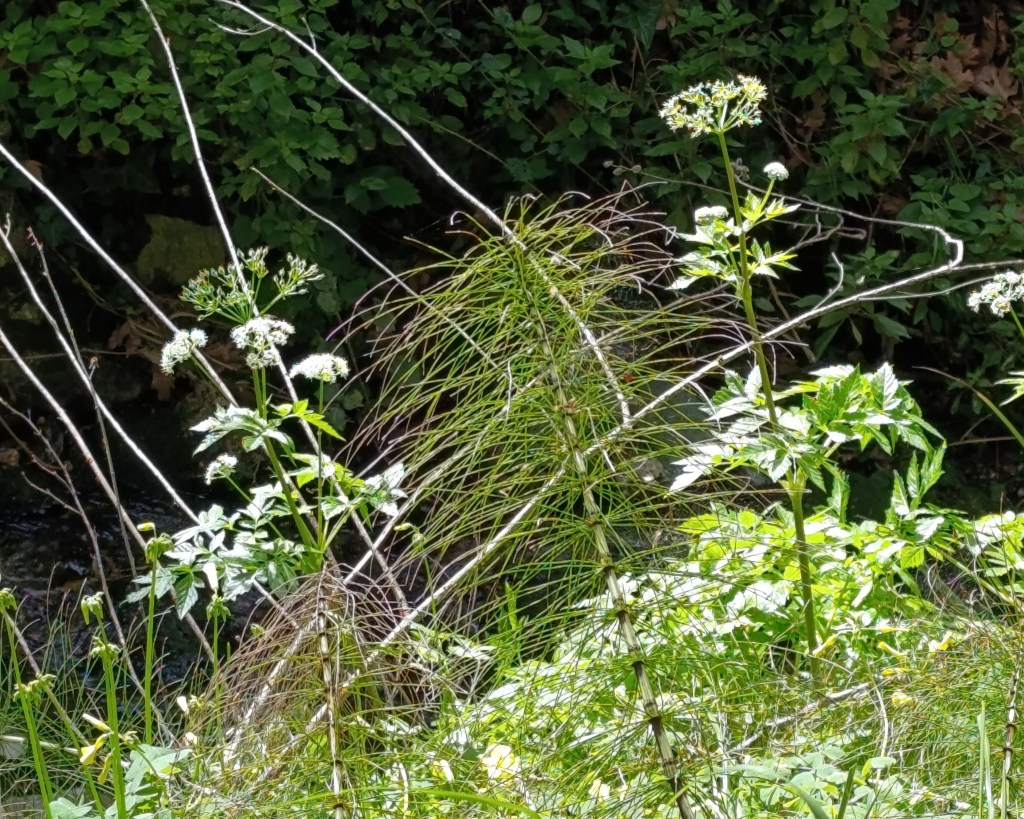
In ancient times, people would peel and candy the stems of wild Angelia, much as they do today with the cultivated variety found in gardens. Though similar, the wild form offers a slightly more bitter taste. Its leaves, when cooked, can be enjoyed much like spinach, while the seeds, prized for their spicy aroma, are used to flavour liqueurs. During the medieval period, wild Angelia was even believed to offer protection against the plague and evil spirits, weaving it into the fabric of folklore and daily life.
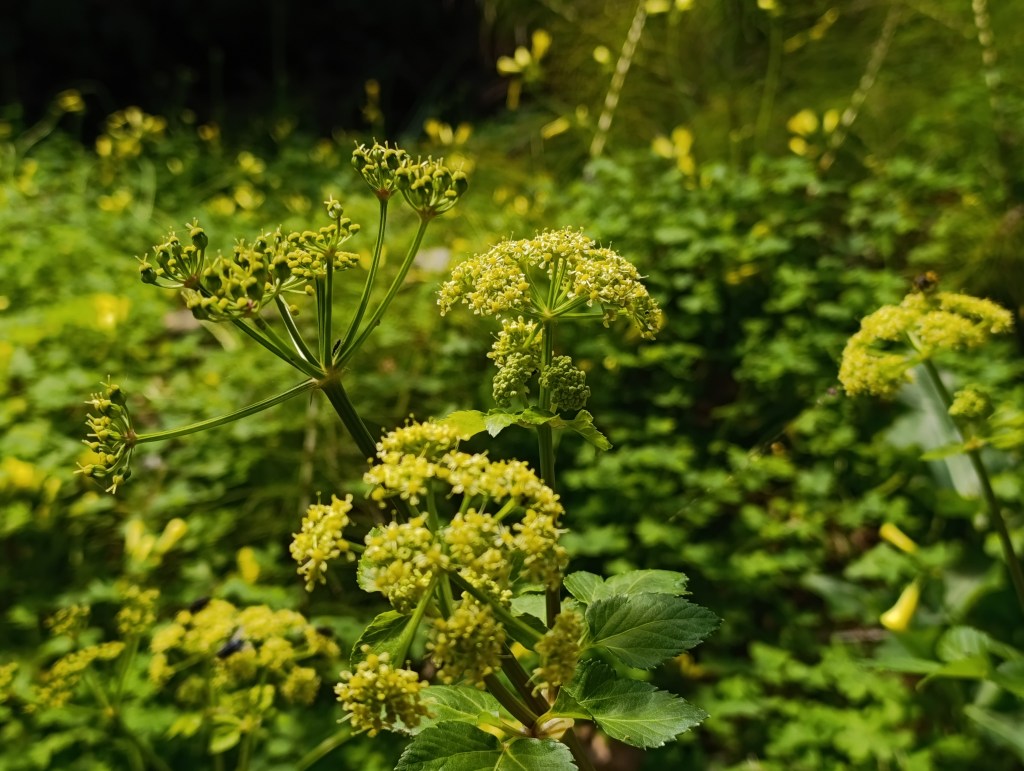
Alexanders, Smyrinium olusatrum (above), rise early in the year, their yellow-green flower clusters growing softly against the dark, glossy leaves. Each leaf divides into three toothed leaflets, reminiscent of wild celery, catching the light like polished jade. Among the carrot family, this plant is often the first to bloom, pushing through the cool breath of winter and heralding the slow unfurling breeze of spring. Brought to Crete by the Romans, Alexanders were once cherished and valued much like celery today. Every part of this plant was edible; the tender stems, the aromatic leaves and even the seeds that carried the warmth of the Mediterranean sun. Their presence on the island may whisper of ancient connections to the Roman city of Lappa, now Argyroupoli, a powerful centre that stood loyal to Emperor Augustus during his struggle against Mark Antony.
Not far from Spili, the ancient city of Lampi, believed by historians to have stood near the modern village of Lampini, was said to have been destroyed in 69 AD by the Roman general Metellus during his conquest of Crete. In these landscapes shaped by conquests, empires, and time, Alexanders, still returns each year, growing quietly along the paths and riverbanks, a living thread between the island’s present and deep, storied past. (Not to be confused with hemlock, which belongs to the same family.)
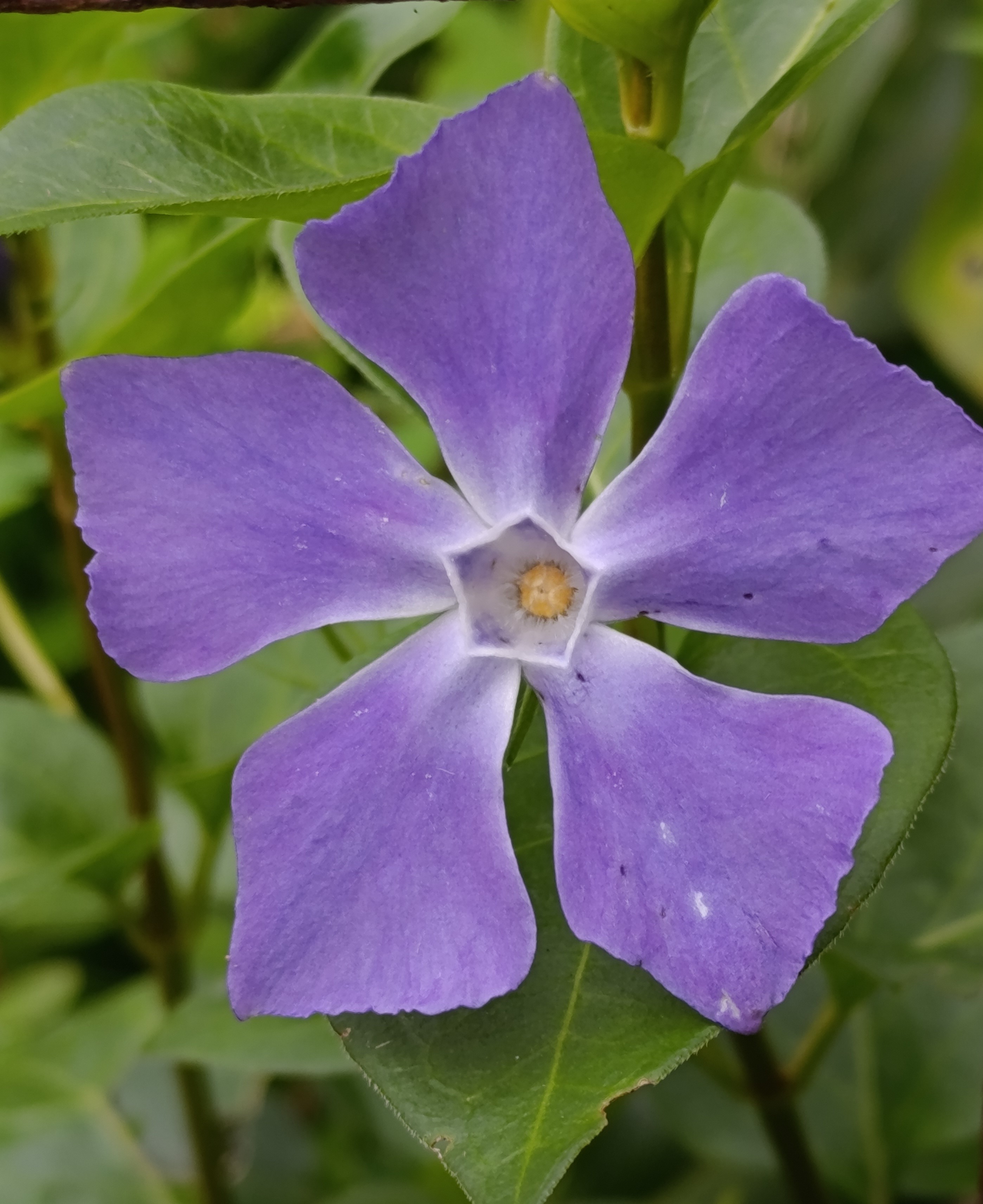
The Greater periwinkle (Vinca major), pictured above right, unfurls along the ground with trailing arcs, its bright blue-violet flowers glowing like small stars against the greenery. Each bloom carries five soft petals, brushed with a hint of white and gathered around a pale central tube. The upper leaves are broad and lance-shaped, while the lower ones form heart-shaped silhouettes on short stalks, giving the plant a graceful, layered appearance.
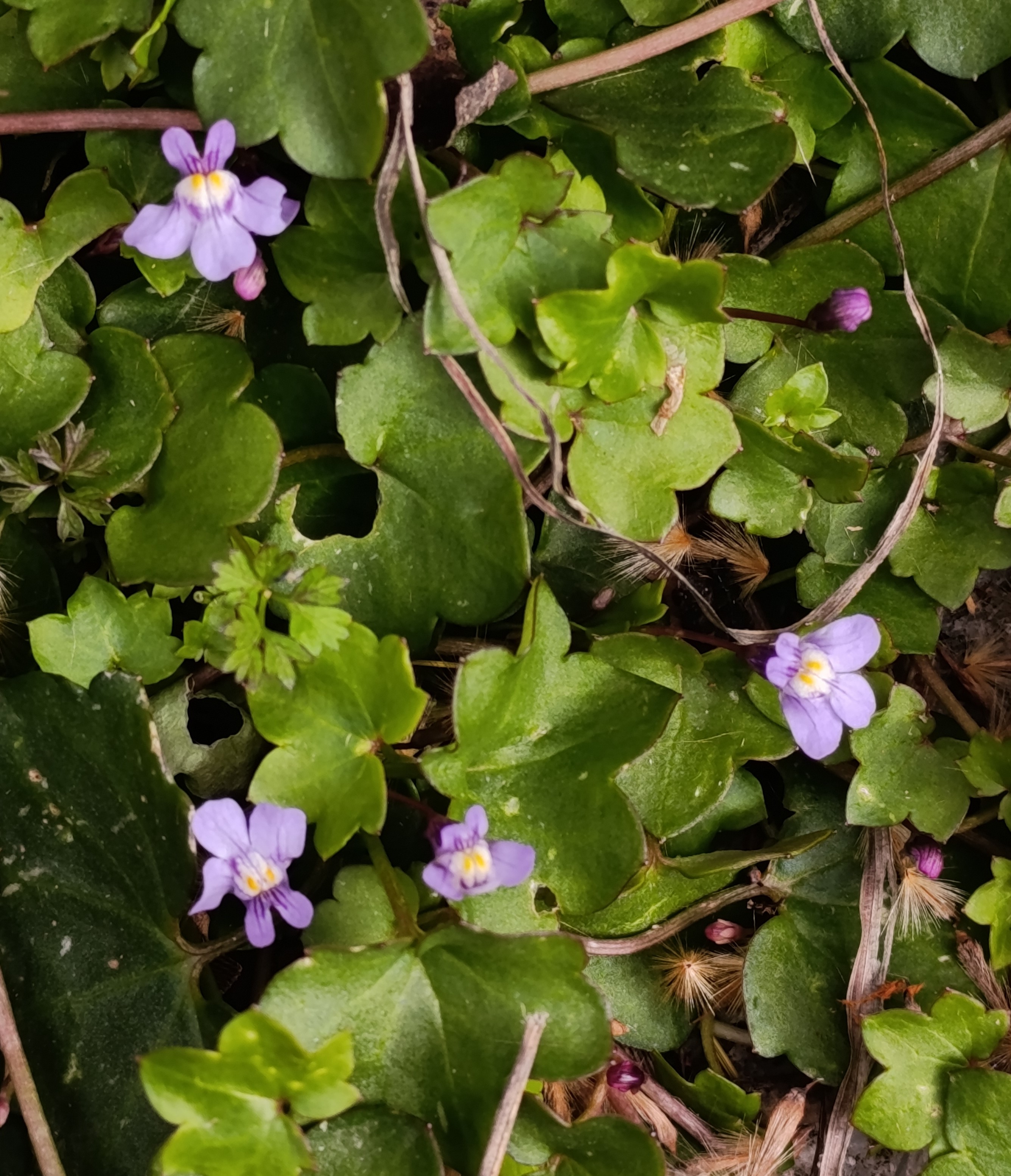
Ivy-leaved toadflax (Cymbalaria muralis), above left, often called the mother of thousands, trails delicately over stone walls, between rocks, along pavements, and at the base of old trees. Its lilac flowers, traced with fine dark lines on the upper lobes, open like tiny faces. Beneath the mouth, two pale lips carry yellow blotches, giving the blooms a lively, almost playful expression. The leaves are thick, rounded and heart-shaped, divided into three to seven, gentle lobes, often tinged with purple underneath. Though small, the flowers resemble miniature snap-dragons, each one a wondrous surprise tucked into the cracks and crevices of the landscape.
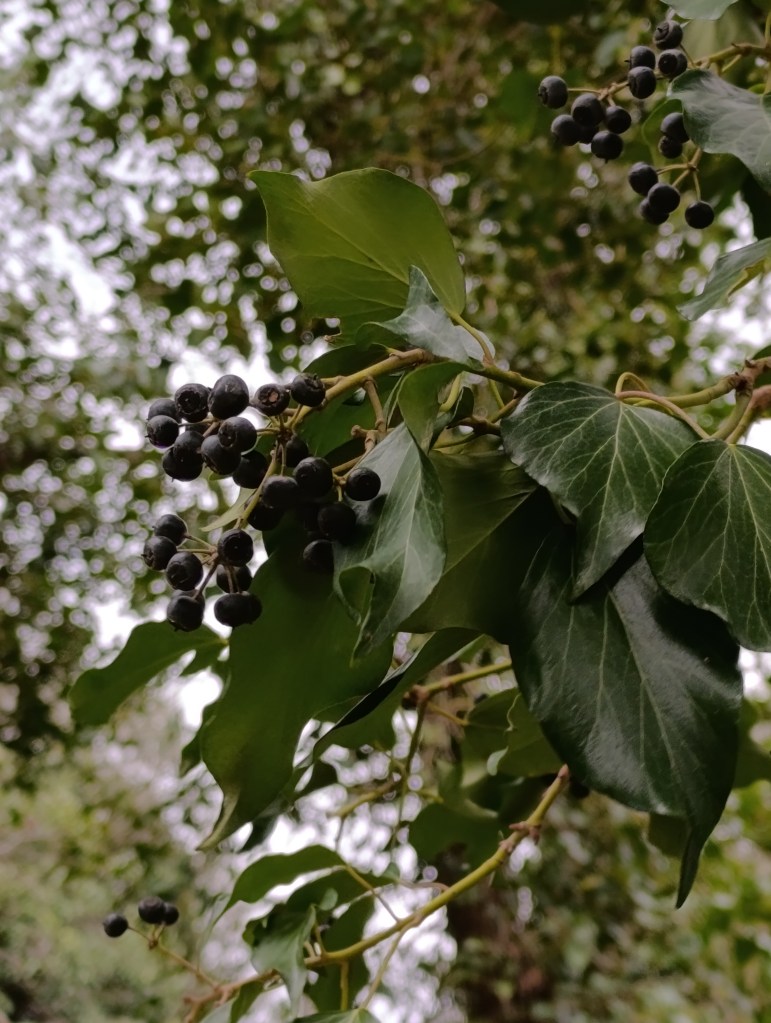
The Hedera helix, the wild ivy, is a woody evergreen climber that moves through the landscape with rapid determination. Its long aerial roots and tendrils cling to bark and stone, allowing it to spiral up trees and old stone walls, sometimes reaching thirty metres as it winds its way towards the light. The leaves, dark green, heart-shaped, and veined with pale lines, form a living tapestry. In late season, small yellow flowers gather into spherical umbels, later giving way to purple-black berries that feed birds throughout the winter. Across the old Greek world, this ivy was believed to be sacred to Dionysus, the god of wine and ecstatic renewal. It symbolised eternal life, continuity and regeneration- qualities reflected in its evergreen persistence.
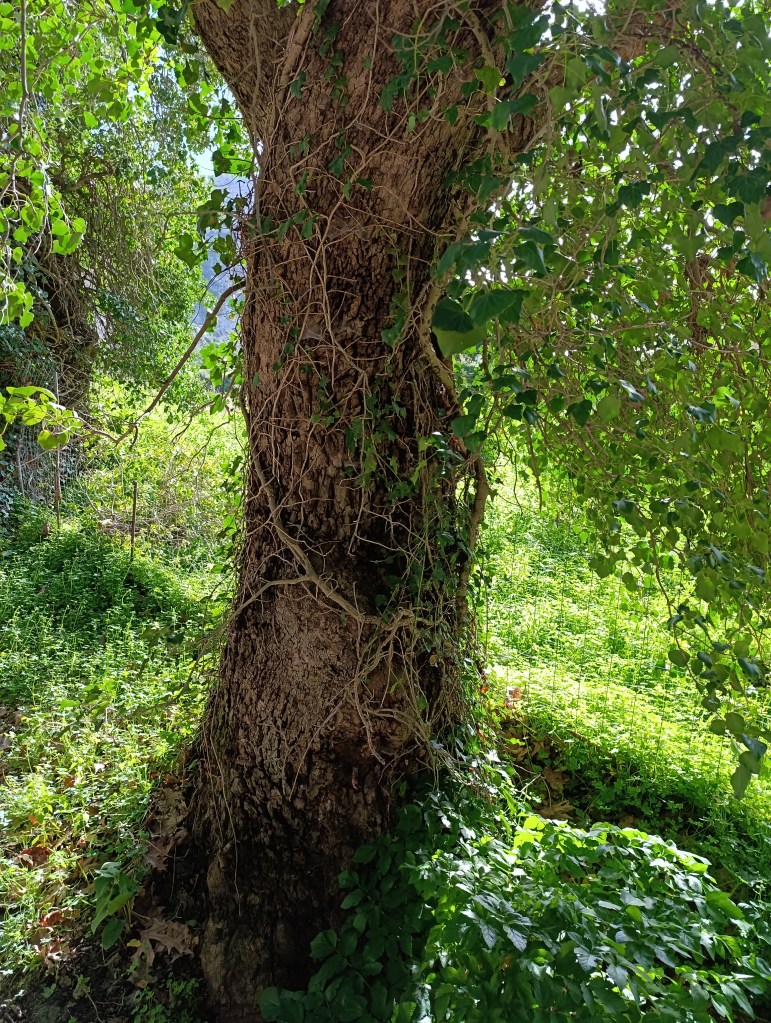
During festivals in his honour, Ivy leaves were woven into garlands and wreaths worn as a sign of devotion and joyful abundance. Myth tells of Cissos, a nimble satyr who loved to dance and climb. During a foot race with Leneus and Ampelus, he leapt so wildly among the trees that he transformed into ivy itself. “Cissos shall creep into a plant,” as the story goes, “and he shall be highflying ivy that entwines about the branches”. In this way, the plant carries the memory of movement of reaching, spreading, embracing whatever it touches.
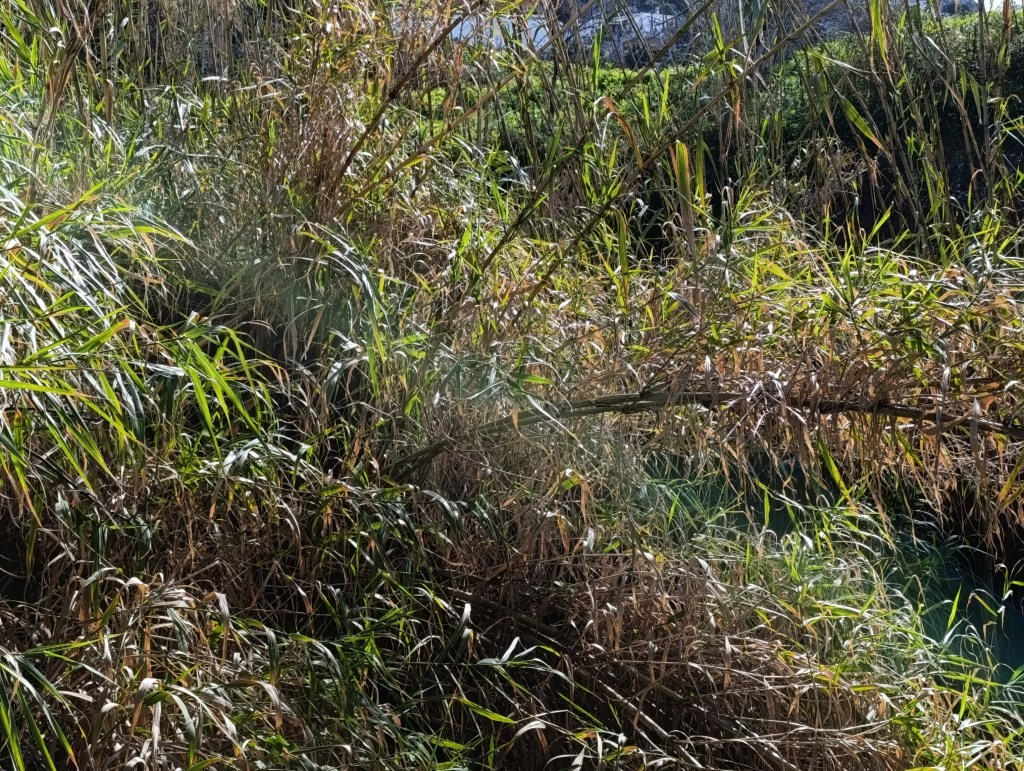
A member of the grass family (pictured above), these water-loving tall reeds grow by the side of the stream. Their thick stems are so strong that strong winds and rushing waters do not break them. They are also natural filters; their strong roots help filter pollutants from the waters. During flowering, this plant produces large feathery plumes at the top of the stalks.
Please watch this video to view the nature walk in spring…
The Village of Spili
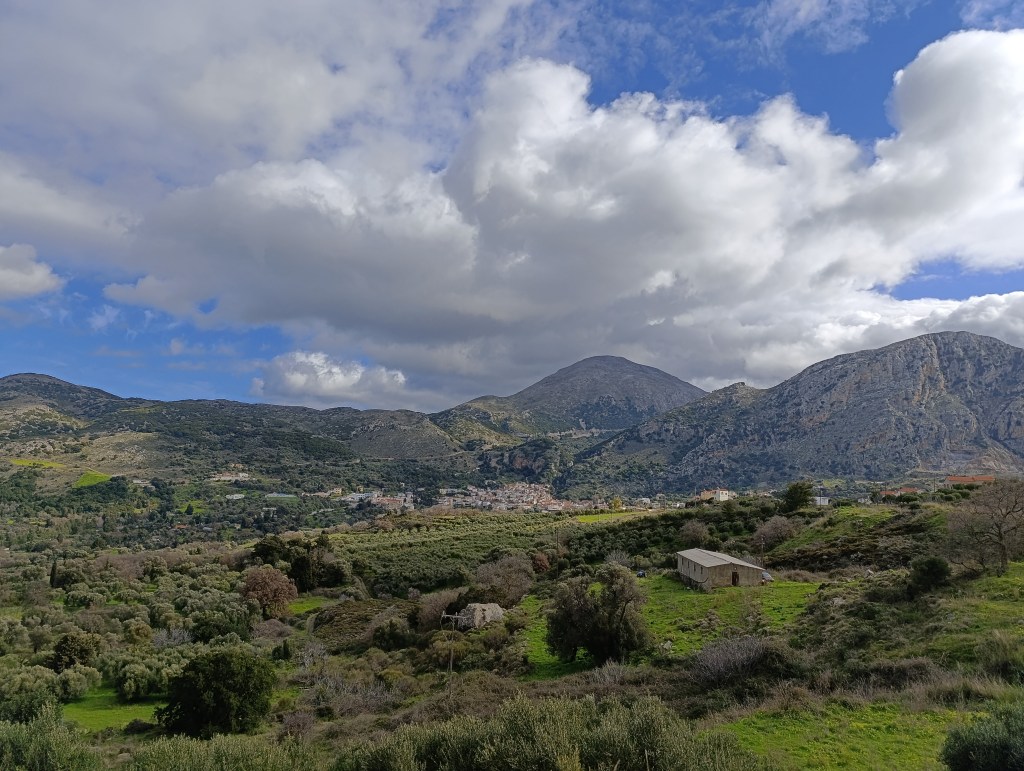
Spili takes its name from the word for cave, echoing the many hollows and hidden caverns that surround the village. Among them once lay the sacred cave of Peristere, where legend tells of a quiet miracle-a figure of the Virgin, shimmering upon the stone within, as if the mountain opened its heart to the inhabitants. The village is known for its warm, lively heart, family-run restaurants and cafes, traditional embroideries and woven fabrics, the local gifts of the land, raki, wine and olive oil. At its centre, twenty-five Venetian lion-headed fountains (Kefalovrissi) release their crystalline waters into a shaded plateau beneath large plane trees. The springs are believed to offer some of the purest water in Crete, flowing from Mount Vorizi, part of the Psiloritis range that rises through the island’s central spine.
 Earthy Spirit
Leave a comment