
Our native bees are declining
Bees play a crucial role in our ecosystem; their contributions are vital for our food supply and the health of our planet.
The decline of bee populations is a global crisis fuelled by habitat loss, disease, parasites, environmental changes, and widespread use of pesticides & chemicals.
Bees are sentient beings; they have the ability to recognize their own thoughts & actions, can feel emotions, and make decisions. Honey bees can share information with fellow bees in the hive by performing a waggle dance, which shows in which direction flowers are available to them and how far away, by using the position of the sun as a compass, and to know what time of day it is. It is also believed that bees have magnetic receptors in their body so they can perceive the Earth’s magnetic field, which helps them with navigation and the building of combs in the hive.
Bees first arrived on Earth approximately 120 million years ago, believed to have evolved from wasps. They were predators who overtime began to share a mutualistic relationship with plants. Their new role was to pollinate flowers, spreading pollen between blooms, while in return every flower would provide bees with food to feed their colony, young, and for honey production, as well as having an important role in the ecosystem.
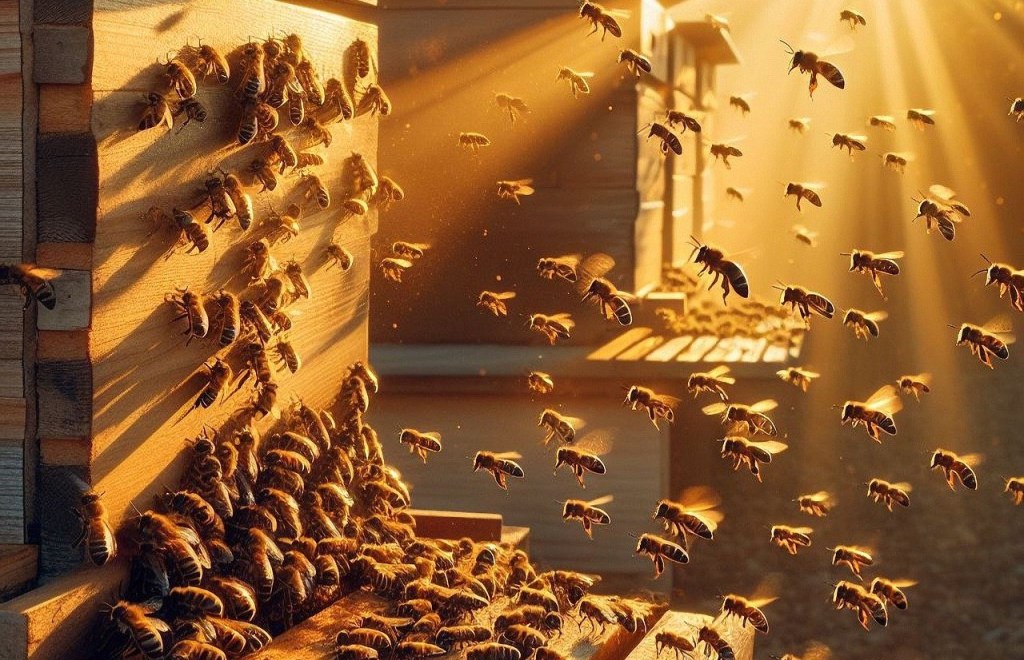
In recent years, countries around the globe have experienced severe consequences from the mass death of bees. Toxic pesticides are widely used on crops, plants, and weeds as a disinfectant to eliminate pests and prevent the growth of fungi. According to recent research, around one million honeybees died in the Upper Rhine Valley and Baden-Württemberg in Germany in 2008, after seed treatments containing pesticides were applied to sweetcorn seeds. These chemicals escaped into the air and contaminated nearby flowering rapeseed crops.
A similar event occurred in France during the 1990s, when thousands of bees died unexpectedly. The cause remained a mystery for many years. Initially, the neonicotinoid insecticide imidacloprid was suspected. However, recent research by a group of researchers from the University of Exeter and Fera Science, involving computer simulations, indicated that fipronil was likely the cause.
In 2008, in Italy, the use of neonicotinoids led to the death of 40,000 bees within just a couple of months, prompting major protests. Then, several years later, on the night of August 7th, 2020, four million bees suddenly perished in a small area of Lombardy. Investigations by forestry officials have been conducted, but the exact cause of these deaths remains uncertain. However, numerous studies on dead bees and honey in Italy suggest a connection to neonicotinoid seed treatments.
The mass bee deaths continued in 2012, when 50 million bees died in Croatia after spraying rapeseed and potatoes with toxic chemicals. 300,000 perished in Coldstream, Scotland, due to the spraying of crops and weeds. 50,000 in the United States and twenty eight million in Romania.
We must recognise the crucial role that bees play in our ecosystems and take action to protect them. Its time to rethink our practices and prioritise a healthier more sustainable environment for these invaluable pollinators.
Download the free e-book below to learn more
Coming soon
"The greatest threat to our planet is the belief that someone else will save it."
Robert Swann

