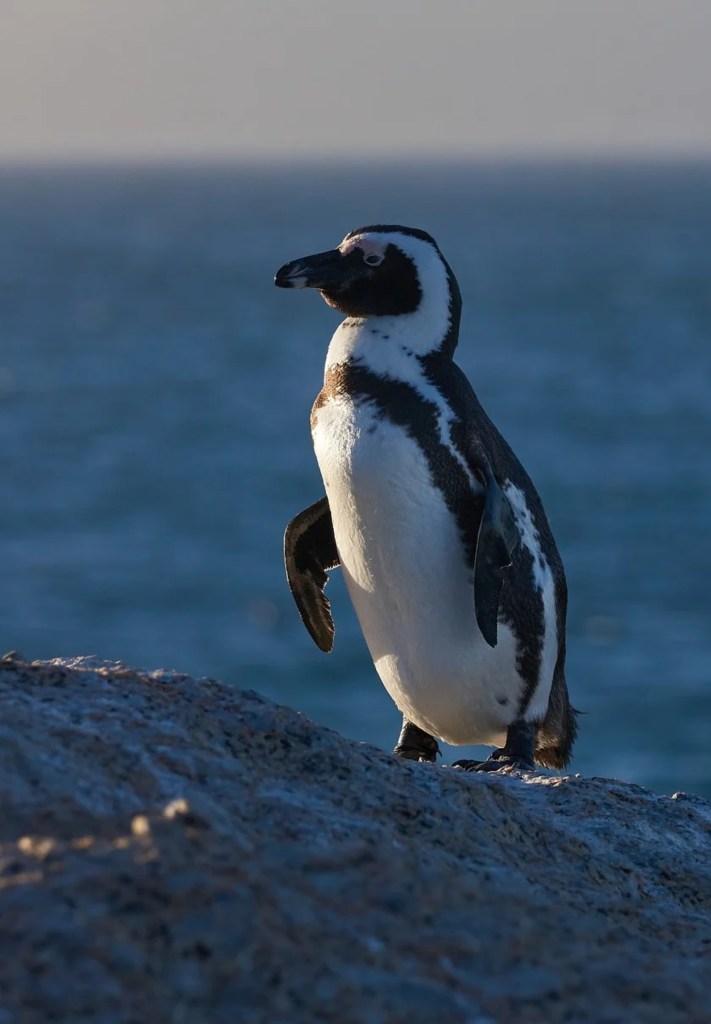
African penguins are native to the white‑sanded shores of Southern Africa and Namibia, with their largest colony found on the Dyer Island nature reserve complex off the coast of Gansbaai, South Africa. This cluster of islets—Dyer, Geyser, and Quoin Rock—provides essential habitat for these striking seabirds. African penguins are easily recognised by their black plumage, dark feet, and bright white belly marked with a curved band and scattered spots that help camouflage them underwater. A distinctive pink patch above each eye acts as a natural cooling system, regulating their body temperature. Females tend to be slightly smaller than males, with more delicate beaks, while their wedge‑shaped flippers allow them to dive as deep as 400 feet in pursuit of sardines, anchovies, and other small fish.
When a male African penguin finds his ideal mate, he presents her with his favourite pebble—a simple, tender gesture of love and affection. Once paired, they form a strong bond and remain together for many breeding seasons. Pebble‑stealing from neighbouring nests is surprisingly common, as males try to adorn their nest and increase their appeal. Together, pairs dig burrows or build guano nests in sand or soil, creating thick layers of eggshell, feathers, and accumulated guano that help insulate their chicks from predators and heat.
An Esso oil tanker spill in 1948 near Quoin Point killed thousands of penguins, followed by another major spill in 1971. By 1982, many breeding pairs relocated from Dyer Island to False Bay, where their numbers have since grown to around 3,000 at Boulders Beach. Despite this recovery, African penguins still remain critically endangered, having declined by roughly 90% since the early 20th century due to habitat loss, overfishing, and repeated oil spills. Today, conservationists construct artificial nesting sites made from fibreglass or cement to improve their chicks survival and to help support the species’ fragile future. The Galápagos penguin faces similar threats and is also considered endangered.

